
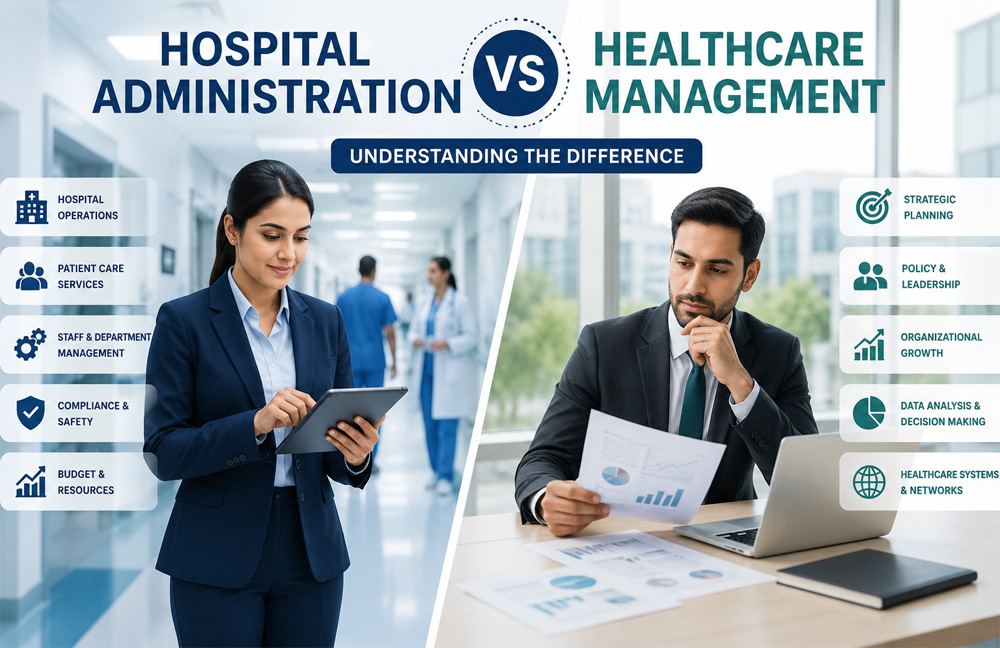
The healthcare industry is one of the fastest-growing sectors globally, providing numerous job opportunities for individuals interested in management and administration. With the increasing complexity of healthcare systems, the need for skilled leaders capable of overseeing hospitals, healthcare facilities, and medical services is steadily growing. Two prominent career choices in this field are Hospital Administration and Healthcare Management.
Although these terms are frequently seen as interchangeable, they signify different fields of knowledge within the healthcare industry. Understanding the differences between Hospital Administration and Healthcare Management is essential for students, aspiring healthcare professionals, and individuals pondering a career in healthcare leadership.
This article explores the key distinctions between Hospital Administration and Healthcare Management, considering their functions, obligations, educational requirements, career outlook, and future possibilities.
Understanding Hospital Administration
Hospital Administration focuses on the management of hospitals and healthcare institutions. Professionals in this field oversee the day-to-day operations of hospitals, ensuring that medical services are delivered efficiently and effectively.
Hospital administrators work quietly to coordinate various departments, manage resources, oversee staff, ensure compliance with healthcare regulations, and maintain excellent patient care standards.
Primary Responsibilities of Hospital Administrators
Hospital administrators have various important duties that include:
- Managing hospital operations
- Supervising administrative staff
- Developing hospital guidelines and procedures
- Budget planning and financial management
- Managing risk assessment and safety measures
- Managing maintenance of facilities and infrastructure
- Guaranteeing healthcare quality standards
- Working together with doctors, nurses, and healthcare personnel
- Ensuring compliance with rules
- Overseeing patient satisfaction programs
Their primary goal is to ensure the hospital functions effectively while delivering high-quality healthcare services.
Understanding Healthcare Management
Healthcare Management encompasses a broader field that involves overseeing and guiding various healthcare organizations, not just hospitals. Healthcare administrators may work in clinics, nursing homes, rehab centers, insurance companies, drug manufacturers, public health institutions, and healthcare consulting firms.
Healthcare administration emphasizes strategic planning, policy implementation, fostering organizational growth, and enhancing healthcare systems broadly.
Primary Responsibilities of Healthcare Administrators
Healthcare managers typically oversee:
- Strategic planning and decision-making
- Execution of healthcare policy
- Leadership within organizations
- Resource allocation
- Monetary planning and expense management
- Management of human resources
- Enhancement of healthcare quality
- Examination of data and healthcare data analysis.
- Public health initiatives
- Business growth in healthcare organizations
Their duties extend beyond hospital boundaries and often encompass managing extensive healthcare networks and systems.
Administración Hospitalaria vs Gestión Sanitaria: Las Principales Diferencias
Although both domains involve managing healthcare services, they differ in their range, responsibilities, and professional focus.
1. Scope of Work
Hospital Administration

- Concentrates specifically on medical centers and healthcare establishments.
- Focuses on operational effectiveness and the provision of patient care.
- Addresses challenges and regulations specific to hospitals.
Healthcare Management
- Covers a wide range of healthcare organizations.
- Comprises hospitals, clinics, insurance firms, NGOs, and healthcare organizations.
- Concentrates on enhancing organizational development and advancing healthcare systems

2.Organizational Emphasis
Hospital administrators mainly oversee the internal functioning of the hospital.
Healthcare administrators emphasize wider organizational strategies and systems for delivering healthcare.
3. Career Environment
Hospital managers typically operate within:

- Hospitals with multiple specialties
- Public healthcare facilities
- Private healthcare facilities
- Specialty healthcare centers
Healthcare Management
- Covers a wide range of healthcare organizations.
- Comprises hospitals, clinics, insurance firms, NGOs, and healthcare organizations.
- Concentrates on enhancing organizational development and advancing healthcare systems

4. Strategic versus Operational Emphasis
Hospital Administration emphasizes:

- Daily operations
- Staff coordination
- Patient services
- Management of facilities
Healthcare Management focuses on:
- Extended-duration strategizing
- Organizational development
- Healthcare regulation
- Market expansion

5. Level of Decision-Making
Hospital administrators often make operational decisions that directly affect hospital functions.
Healthcare managers often engage in strategic decisions at the executive level that affect whole healthcare systems.
Learning Routes
Hospital Administration Programs
Students focused on Hospital Administration usually seek:
- Bachelor of Hospital Administration (BHA)
- Bachelor of Hospital Management (BHM)
- MBA in Hospital Administration
- Master of Hospital Administration (MHA)
- Postgraduate Diploma in Hospital Administration
- Healthcare Management Programs
Students interested in Healthcare Management may choose:

- Bachelor of Healthcare Management
- MBA in Healthcare Management
- Master of Healthcare Administration
- MPH (Master of Public Health)
- Healthcare Leadership Programs
Both educational paths include subjects such as:
- Healthcare Operations
- Medical Ethics
- Healthcare Finance
- Human Resource Management
- Health Information Systems
- Healthcare Law
- Quality Management
- Essential Skills Required
- Skills for Hospital Administrators
Hospital administrators require strong operational and managerial skills.
Key competencies include:

- Leadership
- Communication
- Financial Management
- Problem-Solving
- Team Coordination
- Regulatory Compliance
- Patient Service Management
- Crisis Management
- Skills for Healthcare Managers
Healthcare managers need broader strategic and analytical abilities.
Important skills include:
- Strategic Planning
- Data Analysis
- Policy Development
- Organizational Leadership
- Project Management
- Business Development
- Healthcare Analytics
- Change Management
- Career Opportunities in Hospital Administration
The healthcare sector offers diverse career options for hospital administration graduates.
- Popular Job Roles
- Hospital Administrator
- Operations Manager
- Patient Services Manager
- Medical Superintendent
- Hospital Executive
- Facility Manager
- Quality Assurance Manager
- Healthcare Operations Manager
- Work Settings
Healthcare managers can work in:
- Healthcare Corporations
- Insurance Companies
- Public Health Organizations
- Pharmaceutical Firms
- Research Institutions
- Healthcare Technology Companies
- International Healthcare Agencies
- Salary Comparison
Salary levels vary depending on education, experience, organization, and location.
Hospital Administration
- Entry-Level: ₹3–6 LPA in India
- Mid-Level: ₹6–12 LPA
- Senior-Level: ₹15–30 LPA or more